
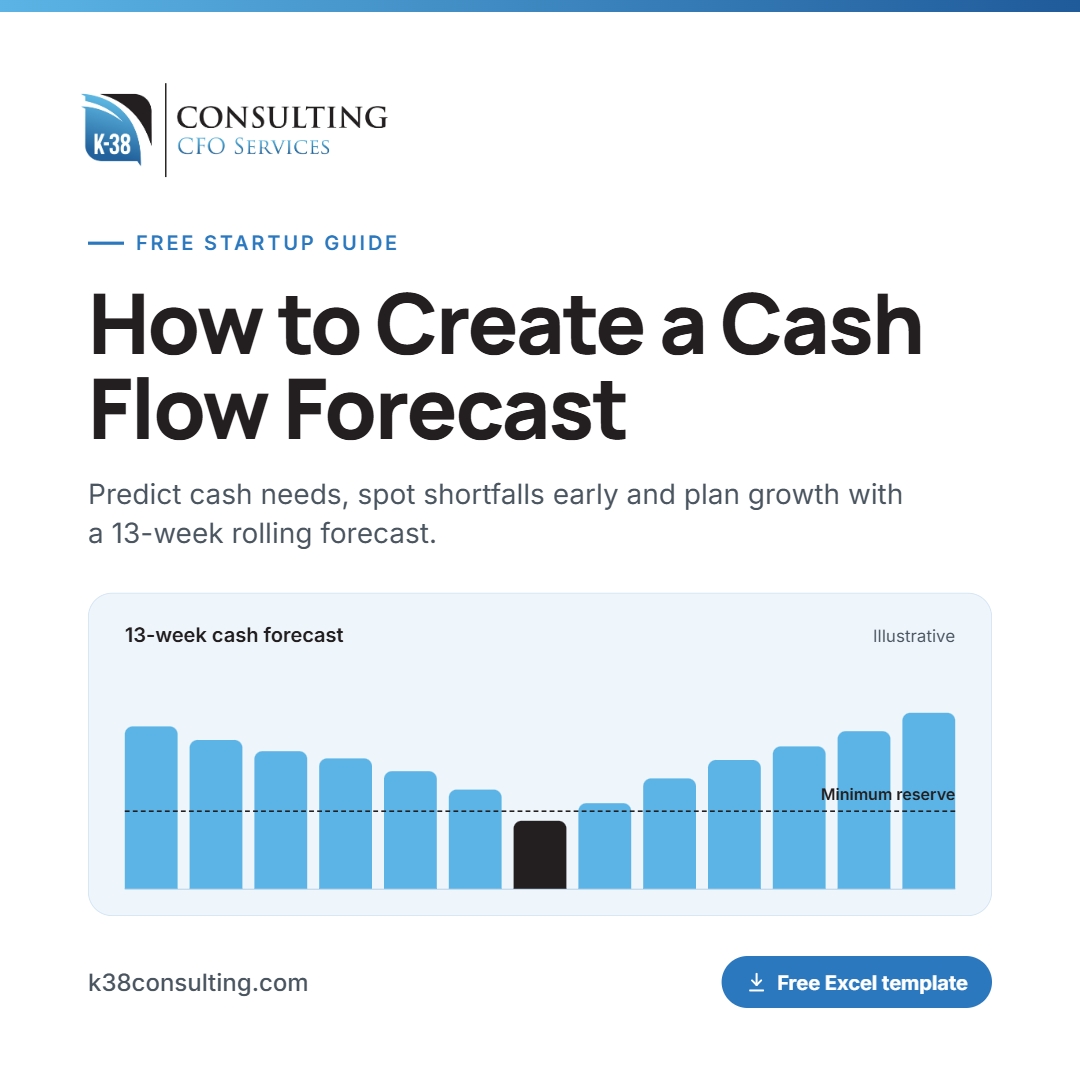
RALEIGH, N.C. – October 26, 2026 – K-38 Consulting, a provider of outsourced CFO services, fractional CFO and controller services for startups and growing companies, today announced the release of How to Create a Cash Flow Forecast: Easy Startup Guide, a free, in-depth resource that walks founders and finance teams through building a cash flow forecast from scratch. The guide explains the core components of cash flow forecasting, compares the direct and indirect methods, and provides a practical framework for a 13-week rolling cash flow forecast, along with a free downloadable Excel template.
The guide addresses one of the most common and costly gaps in early-stage companies: the difference between profit and cash. A startup can grow sales and still run short of cash when customers pay late, expenses come due early, or financing takes longer than planned. K-38 Consulting’s new resource turns those timing differences into a repeatable planning process that management can review and update every week.
Why cash flow forecasting matters for startups
A cash flow forecast estimates the timing and amount of cash expected to enter and leave a business over a defined period. It starts with an opening cash balance, adds expected receipts, subtracts expected payments and calculates a closing balance for each period. Unlike an income statement, which records revenue and expenses when they are earned or incurred, a cash forecast focuses on when money actually reaches or leaves the bank account.
For founders, that distinction drives real decisions. A regularly maintained forecast helps a startup see when available cash may fall below its operating reserve, plan payroll, supplier and tax payments, time new hires and equipment purchases, and explain cash needs to investors and lenders with confidence.
“Most founders watch revenue closely, but revenue doesn’t pay the bills. Cash does,” said Dallas L Alford IV, CPA, Managing Partner of K-38 Consulting. “We wrote this guide because we see the same pattern again and again: a company is growing, the income statement looks healthy, and then a late customer payment and an annual software renewal land in the same month. A simple, honest forecast makes that visible weeks in advance, while there’s still time to act.”
What the guide covers
The guide is organized into six practical sections, written for founders who may not have a finance background:
- Understanding cash flow forecasting — definitions, how to choose a forecast horizon (daily or weekly, 13 weeks, or 12–18 months), and the five core components every forecast should track: opening balance, inflows, outflows, net cash movement and closing balance.
- Gathering the right data — how to map expected receipts and payments, separate committed funding from speculative fundraising, and classify fixed, variable and step costs. It also highlights supporting metrics such as days sales outstanding, cash runway, operating cash burn and the cash conversion cycle.
- Direct vs. indirect cash flow forecasting — when to use each method, how venture-backed and bootstrapped startups can apply them differently, and why many finance teams use both.
- Building a 13-week rolling cash flow forecast — a six-step process with a worked example and a free Excel template.
- Using financial systems — how QuickBooks Online, Oracle NetSuite, Stripe and Ramp can feed a forecast, and how to keep integrated data accurate.
- Avoiding common forecasting mistakes — overestimating collections, mistiming expenses, ignoring seasonality and failing to update the model.
The 13-week rolling forecast: a CFO-preferred tool
At the center of the guide is the 13-week rolling cash flow forecast, a weekly model that covers roughly one quarter and is extended by one week each time a week closes. The guide breaks the process into six steps: record and reconcile the opening cash balance, forecast inflows by expected receipt date, forecast outflows by expected payment date, calculate the weekly cash position, flag shortfalls and runway risks against a minimum operating reserve, and update the model every week with actual results.
The guide recommends testing base, downside and upside scenarios for delayed collections, higher expenses, slower sales or shifts in financing timing. To help readers get started, K-38 Consulting includes an illustrative three-week example and a free 13-Week Cash Flow Forecast Template in Excel that teams can adapt with their own data.
“The 13-week forecast is the single most useful cash tool a startup can adopt,” said Alford. “It’s detailed enough to guide this week’s payment decisions and long enough to show when you’ll need to raise, cut or collect. The key is updating it every week and comparing it against what actually happened.”
Connecting modern finance tools without losing accuracy
The guide also explains how common startup finance tools can support forecasting. Accounting records from QuickBooks Online or NetSuite can establish a baseline. Stripe data can inform settlement timing, fees, refunds and chargebacks. Spend-management data from Ramp can surface upcoming and approved spending.
K-38 Consulting cautions that integrations reduce manual work but do not guarantee accuracy. The guide recommends naming a single source of truth for each input, aligning forecasts to expected cash dates rather than invoice dates, preventing duplicate entries, checking data refresh timing and reviewing variances every week.
Avoiding the most common forecasting mistakes
The final section focuses on errors that quietly undermine forecasts. These include treating pipeline deals, unsigned contracts or overdue invoices as guaranteed cash; recording expenses in the wrong period; ignoring seasonality and one-off items; and letting the model go stale. The guide’s central message is that a forecast is a decision-making tool, not a guarantee, and its value depends on realistic assumptions, clear ownership and regular comparison with actual cash activity.
Key takeaways for founders
- A cash flow forecast tracks when cash moves, not when revenue is earned.
- The basic formula is: closing cash balance = opening cash balance + cash inflows − cash outflows.
- A 13-week rolling forecast suits weekly liquidity management; a 12–18 month monthly forecast supports budgeting, hiring and fundraising.
- The direct method is best for near-term cash control; the indirect method links cash to projected profitability and the balance sheet.
- Forecasts should be reconciled to bank records and updated weekly.
Frequently asked questions
What is a cash flow forecast? A cash flow forecast estimates the money expected to move into and out of a business over a set period. It helps founders spot cash shortages, plan payments and communicate cash needs to stakeholders.
How do you create a basic cash flow forecast? Start with a reconciled opening cash balance, estimate receipts and payments by their expected dates, calculate net cash movement and add it to the opening balance to find the closing balance. Then compare actual results with the forecast and update assumptions regularly.
Why do CFOs prefer a 13-week rolling cash flow forecast? It gives a detailed weekly view of receipts, payments and liquidity risk across about one quarter. Rolling it forward every week keeps it aligned with actual cash movements.
How often should a cash flow forecast be updated? A 13-week forecast should generally be updated weekly, and also after major events such as a delayed customer payment, an unexpected expense or a financing milestone. Longer-term forecasts can be reviewed monthly or quarterly.
What is a safe cash runway buffer for a Series A startup? There is no single safe number. The right reserve depends on monthly burn, revenue predictability, fundraising conditions and the time needed to reach the next milestone, so management should model downside scenarios, including delayed fundraising.
Availability
How to Create a Cash Flow Forecast: Easy Startup Guide is available now, free of charge, on the K-38 Consulting blog at k38consulting.com/how-to-create-a-cash-flow-forecast-3. The 13-Week Cash Flow Forecast Template can be downloaded directly from the guide.
Founders who want help applying the framework to their own business can book a free 30-minute strategy call with the K-38 Consulting team to discuss cash flow forecasting, financial planning and near-term liquidity needs.
About K-38 Consulting
K-38 Consulting is a Raleigh, North Carolina-based financial services firm that provides fractional CFO services, outsourced CFO services, controller services, R&D tax credit support and cost segregation services to startups and growing companies. The firm serves clients across industries including SaaS, biotech, healthcare, e-commerce, consumer packaged goods, law firms, real estate and construction, with service locations including Raleigh, Charlotte, Atlanta, Tampa, Miami, Austin, Chicago, New York City, San Francisco, San Jose and Los Angeles. According to the company, its clients have raised more than $10 billion in funding. K-38 Consulting also publishes free resources for founders, including financial model templates, cash flow ebooks and an accounting Q&A library. Learn more at k38consulting.com.
Media Contact
Company Name: K38 Consulting, LLC
Contact Person: Dallas Alford
Email: Send Email
Phone: 9102624412
Address:3809 La Costa Way
City: Raleigh
State: NC
Country: United States
Website: https://www.k38consulting.com/
Press Release Distributed by ABNewswire.com
To view the original version on ABNewswire visit: K-38 Consulting Releases Free Startup Guide on How to Create a Cash Flow Forecast, Including a 13-Week Rolling Forecast Template


