The Business Research Company’s Baby Care Products Global Market Report 2026 – Market Size, Trends, And Forecast 2026-2035
LONDON, GREATER LONDON, UNITED KINGDOM, October 12, 2026 /EINPresswire.com/ — The baby care products market is gaining substantial traction as awareness around infant health and hygiene grows worldwide. With increasing consumer demand for natural and organic options and the expansion of premium products through digital platforms, this sector is set for remarkable development over the coming years. Let’s explore the current market landscape, what’s driving growth, key players, and future opportunities in this evolving industry.
Market Size and Projected Growth of the Baby Care Products Market
The baby care products market is anticipated to surpass $109 billion by 2030. This segment forms a significant part of its parent Toiletries market, which is expected to reach nearly $460 billion by the same year, with baby care accounting for roughly 24% of that total. In the larger context of the Chemicals industry, forecasted at $7,007 billion by 2030, baby care products represent close to 2% of the overall value, highlighting their importance within the broader market.
Request A Free Sample Of The Baby Care Products Market Report
https://thebusinessresearchcompany.com/sample_request?id=47751769&type=smp&name=Baby%20Care%20Products%20Market%20Report%202026&utm_source=EINPresswire&utm_medium=Paid&utm_campaign=Oct_PR
Key Influences Stimulating Growth in the Baby Care Products Market
One major factor propelling this market’s expansion is the rising awareness about infant health and hygiene. More parents are choosing products specifically designed for babies’ delicate skin to prevent common issues like diaper rash, allergies, and irritation. This shift is supported by guidance from pediatric experts, parenting resources, better healthcare access, and increased spending on preventive care, which together contribute approximately 2.8% to annual market growth.
Another vital driver is the growing preference for organic and natural baby care products. Consumers now favor items made with plant-based, hypoallergenic, and chemical-free ingredients, seeking transparency regarding sustainability and formula contents. This has encouraged brands to develop certified organic and clean-label ranges that cater to health-conscious parents, adding about 2.6% annual growth to the market.
Access The Detailed Baby Care Products Market Report Here
https://thebusinessresearchcompany.com/report/baby-care-products-global-market-report?utm_source=EINPresswire&utm_medium=Paid&utm_campaign=Oct_PR
The expanding reach of e-commerce platforms further fuels market growth by providing customers with easy access to a broad array of domestic and international brands. These platforms offer convenient features such as product comparisons, subscription services, personalized recommendations, and home delivery. Combined with aggressive digital marketing, these factors are extending premium product availability to urban and underserved regions, contributing roughly 2.2% to yearly growth.
How the Baby Care Products Market is Categorized and Its Leading Segment
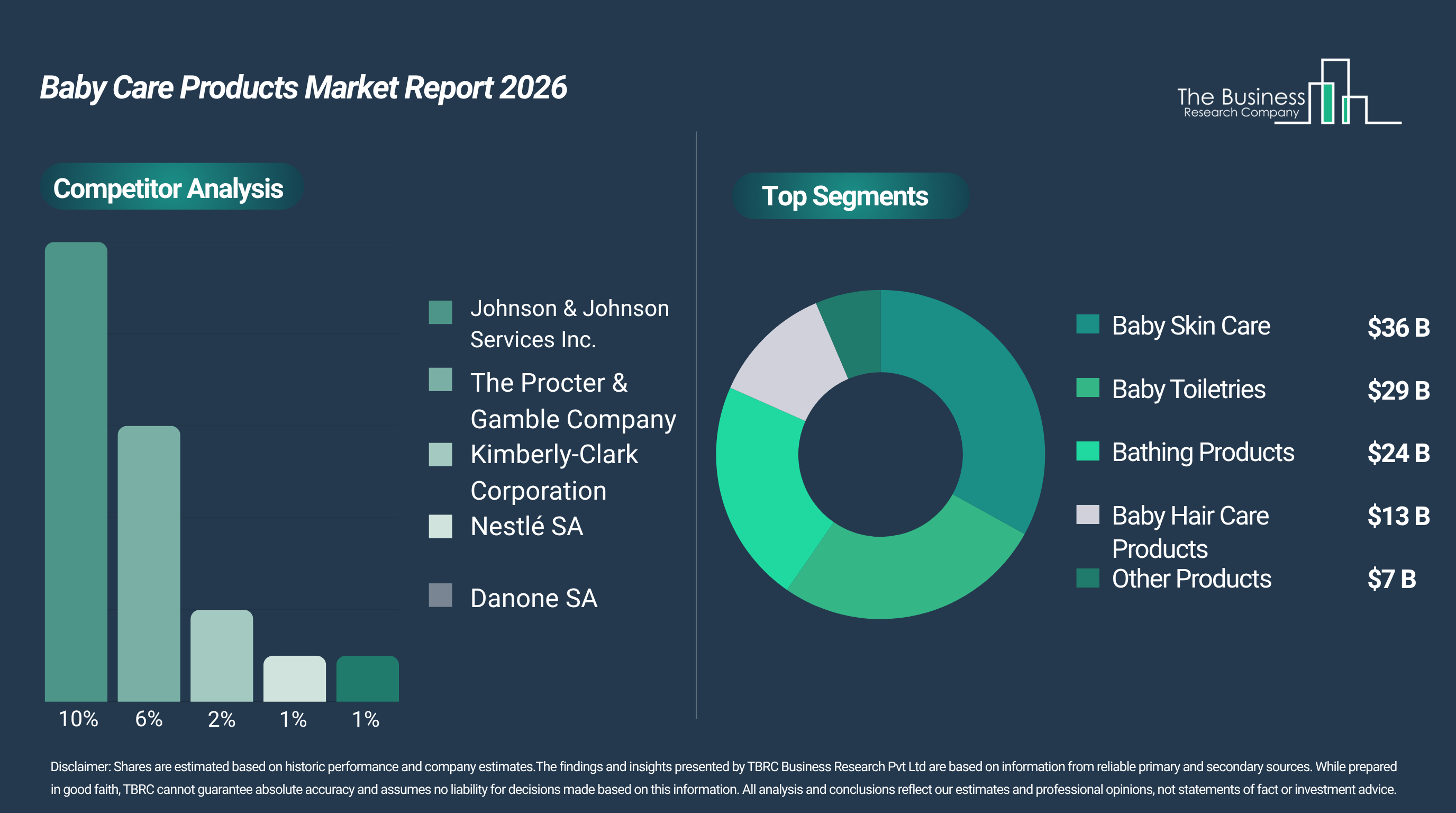
The baby care products market breaks down into several main categories: baby skin care, baby hair care, bathing products, baby toiletries, and other related items. Among these, baby skin care emerges as the largest segment, expected to hold 33% of the market share by 2030, equivalent to $36 billion. This segment thrives due to the demand for gentle moisturizing and protective products, hypoallergenic and pediatrician-approved formulas, heightened awareness of infant skin sensitivity, and advancements in natural ingredient innovations that help nurture delicate skin.
Additional ways to segment the market include buyer type—divided into institutional and residential purchasers—and distribution channels, which encompass online platforms, department stores, specialty outlets, supermarkets, and other retail forms.
Regional Growth Outlook for the Baby Care Products Market
Asia-Pacific is projected to be the dominant region in the baby care products market by 2030, valued at $44 billion, up from $27 billion in 2025. This growth, with a compound annual growth rate of 10%, is fueled by higher birth rates in developing countries, increased household spending on infant wellness, rising awareness of premium products among parents, and broader availability of branded items via organized retail and online sales.
Country-Specific Market Forecast: The United States
The United States is expected to lead as the largest individual country market, reaching $19 billion by 2030 from $13 billion in 2025, marking a 7% CAGR. Growth is driven by a preference for dermatologist-tested baby care items, demand for organic and chemical-free formulas, rising consumer spending on premium infant essentials by younger families, and ongoing innovation focused on safety, comfort, and skin health.
Competitive Landscape in the Baby Care Products Market
The baby care products market is shaped by a mix of global consumer goods giants and specialist infant care manufacturers. These companies continually invest in developing advanced skincare solutions, sustainable and safe product innovations, personalized nutrition, and convenient hygiene items to align with evolving parental expectations. Success within this sector depends heavily on rigorous safety standards, the use of natural and organic ingredients, a strong commitment to infant health, and effective digital engagement with consumers.
In 2025, Johnson & Johnson Services Inc. led global sales with a 10% market share. Its consumer health division offers a comprehensive range of baby skincare, hygiene, and personal care products designed to support infant health, comfort, and daily routines.
Market Fragmentation and Competitive Intensity Among Baby Care Brands
The baby care products market exhibits moderate fragmentation, with the top 10 companies accounting for 21% of revenue in 2025. This dynamic reflects moderate brand loyalty and several entry barriers such as established trust in leading brands, stringent safety and quality regulations, broad distribution networks, robust research and development capabilities, and the necessity to adapt to shifting parental preferences and infant health needs. Market leaders maintain strong positions through diversified product lines, well-recognized brands, extensive retail and e-commerce presence, longstanding consumer connections, and continual innovation in hygiene, skincare, nutrition, and wellness.
The major players and their respective market shares in 2025 include:
– Johnson & Johnson Services Inc. (10%)
– The Procter & Gamble Company (6%)
– Kimberly-Clark Corporation (2%)
– Nestlé SA (1%)
– Danone SA (1%)
– Pigeon Corporation (0.2%)
– Abbott Laboratories (0.2%)
– Unicharm Corporation (0.1%)
– Beiersdorf AG (0.1%)
– L’Oréal SA (0.1%)
Emerging Trends Transforming the Baby Care Products Market
A key trend reshaping this sector is the rise of toxin-free baby care formulations. These products emphasize enhanced safety for infant skin through gentle nourishment derived from natural, dermatologically tested ingredients. For example, in September 2025, Panacea Biotec launched the NikoMom baby skin care line designed for newborns. It features plant-based components, natural oils, vitamins, and proprietary technologies like Hydranest, TenderNest, DermaNest, and HealNest that provide added skincare benefits, meeting growing demand for safe, scientifically formulated infant products.
Where the Biggest Growth Opportunities Lie in Baby Care
Significant growth prospects are present across baby skin care, baby toiletries, bathing products, baby hair care, and other related items. Together, these categories are expected to add more than $41 billion in market value by 2030. Baby skin care alone is anticipated to grow by $14 billion, baby toiletries by $11 billion, bathing products by $9 billion, baby hair care products by $5 billion, and other products by $2 billion between 2025 and 2030. Drivers include dermatologist-recommended formulations, sustainable and refillable packaging, multifunctional infant care innovations, and wider availability of premium, customized products across both digital and physical retail platforms.
How Market Players Are Staying Competitive and Relevant
Companies in this space are focusing on advancing natural baby care ingredients to enhance infant safety and protection. They also emphasize designs that improve comfort and hygiene, expand sustainable product options to promote safety and environmental responsibility, and integrate skincare technologies that boost moisturization and overall infant skin health.
Who Are the Key Players in the Baby Care Products Industry
Prominent companies active in the baby care products market include Johnson & Johnson Services Inc., The Procter & Gamble Company, Kimberly-Clark Corporation, Nestlé SA, Danone SA, Pigeon Corporation, Abbott Laboratories, Unicharm Corporation, Beiersdorf AG, L’Oréal SA, Artsana Group, Munchkin Inc., Dabur India Limited, The Himalaya Drug Company Ltd., Baby Boom Consumer Products Inc., Burt’s Bees Inc., Sebapharma GmbH & Co. KG, LUV N Care Ltd., Avon Products Inc., and Me N Moms Private Ltd.
The Baby Care Products Market Ecosystem and Its Participants
The wider ecosystem consists of raw material suppliers such as BASF SE, Dow Inc., Evonik Industries AG, Croda International Plc, Lubrizol Corporation, Ashland Global Holdings Inc., Clariant AG, Solvay S.A., Wacker Chemie AG, Eastman Chemical Company, Huntsman Corporation, Covestro AG, Nouryon Holding B.V., Momentive Performance Materials Inc., Shin-Etsu Chemical Co., Ltd., Kao Corporation, Givaudan SA, International Flavors & Fragrances Inc., Firmenich SA, Sensient Technologies Corporation, DuPont de Nemours, Inc., Berry Global Group, Inc., and Avery Dennison Corporation.
Wholesalers and distributors also play a vital role, including McKesson Corporation, Cardinal Health, Inc., AmerisourceBergen Corporation (Cencora), Unicharm Corporation Distribution Network, DKSH Holding Ltd., Brenntag SE, IMCD N.V., Univar Solutions Inc., Henry Schein, Inc., Medline Industries, LP, Bunzl plc, Sysco Corporation, Gordon Food Service, Performance Food Group Company, KeHE Distributors LLC, United Natural Foods, Inc., SpartanNash Company, Core-Mark International, Inc., Havi Global Solutions, Linfox Logistics, Kuehne + Nagel International AG, DHL Supply Chain, FedEx Supply Chain, CEVA Logistics, and Ryder System, Inc.
End users range widely from large retailers such as Walmart, Target, Costco Wholesale, Tesco, Carrefour, Reliance Retail, Avenue Supermarts, Amazon, Flipkart, and FirstCry, to healthcare providers like Apollo Hospitals, Fortis Healthcare, and Max Healthcare, as well as specialty baby and pharmacy chains including Mothercare, Boots, Walgreens, CVS Health, Kroger, and Albertsons.
Our 2026 market reports now feature expanded strategic intelligence through market attractiveness scoring and analysis, total addressable market (TAM) analysis, company scoring matrix graphics and tables, Excel-based dashboards, market hotspots infographics, key technology and future trend analysis, along with updated graphics and tables.
Learn More About The Business Research Company
The Business Research Company (www.thebusinessresearchcompany.com) is a leading market intelligence firm renowned for its expertise in company, market, and consumer research. We have published over 30,000+ reports across 27 industries and 60+ geographies. Our research is powered by 1,500,000 datasets, extensive secondary research, and exclusive insights from interviews with industry leaders.
We provide continuous and custom research services, offering a range of specialized packages tailored to your needs, including Market Entry Research Package, Competitor Tracking Package, Supplier & Distributor Package and much more.
Disclaimer: Please note that the findings, conclusions and recommendations that TBRC Business Research Pvt Ltd delivers are based on information gathered in good faith from both primary and secondary sources, whose accuracy we are not always in a position to guarantee. As such TBRC Business Research Pvt Ltd can accept no liability whatever for actions taken based on any information that may subsequently prove to be incorrect. Analysis and findings included in TBRC reports and presentations are our estimates, opinions and are not intended as statements of fact or investment guidance.
Contact Us:
The Business Research Company
Americas +1 310-496-7795
Europe +44 7882 955267
Asia & Others +44 7882 955267 & +91 8897263534
Email: marketing@tbrc.info
Follow Us On:
LinkedIn: https://in.linkedin.com/company/the-business-research-company
Oliver Guirdham
The Business Research Company
+44 7882 955267
Visit us on social media:
LinkedIn
Facebook
X
Legal Disclaimer:
EIN Presswire provides this news content “as is” without warranty of any kind. We do not accept any responsibility or liability
for the accuracy, content, images, videos, licenses, completeness, legality, or reliability of the information contained in this
article. If you have any complaints or copyright issues related to this article, kindly contact the author above.

Media gallery