
Originally Posted On: https://www.ucanpack.com/blog/post/how-to-switch-from-free-carrier-packaging-to-your-own-shipping-boxes-this-month
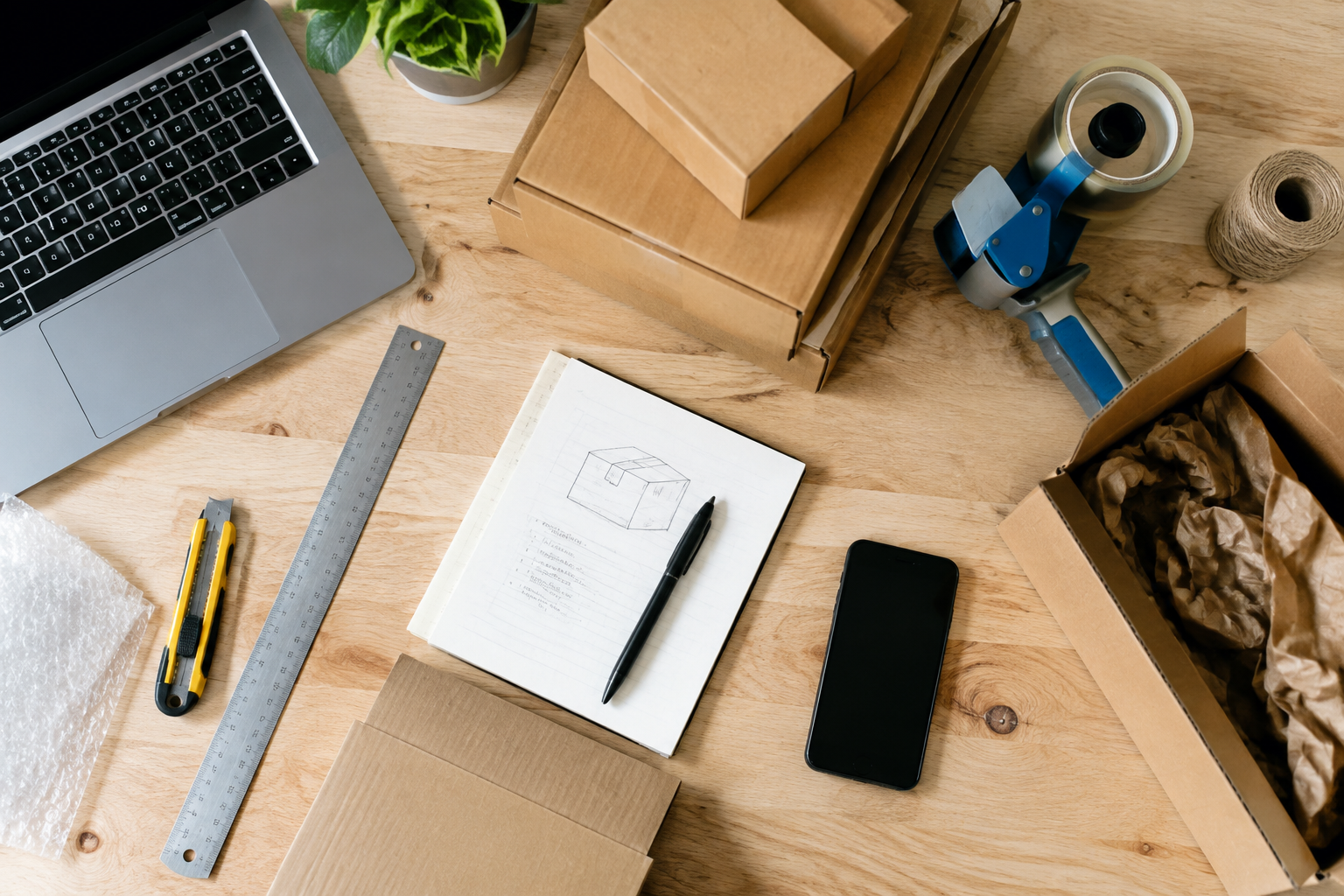
What You'll Need
Dana here. Block out about 3 to 5 hours spread over a week, plus whatever transit time your samples take. Nothing here takes special skills. If you can use a tape measure and a spreadsheet, you're set.
-
Your last 30 days of orders exported from Etsy, Amazon, or your cart. You need SKU, quantity, and the carrier box size you used.
-
A tape measure or ruler and a postal or kitchen scale that reads to the ounce.
-
A simple spreadsheet with columns for length, width, height, weight, and fragility (low, medium, high).
-
Your current damage and return numbers. Even a rough count works, like 6 broken items out of 400 orders. You'll compare against this later.
-
Three to five sample boxes in the sizes your audit points to. Get at least two flute grades, such as E-flute and B-flute, so you can test both.
-
Cushioning on hand: kraft paper, crinkle paper, or bubble wrap for your drop tests.
-
Packing tape (2-inch hand-grade is fine) if you're choosing boxes that need sealing.
-
A budget ceiling per shipment. Know the most you'll spend on the box itself before you start comparing suppliers.
-
Ten spare minutes per product for a rough drop test from waist height.
Skip the big first order. Buy a small batch of 25 to 100 per size, and scale up once your damage rate holds steady.
One crushed corner can wipe out the profit on ten orders. Dana has watched sellers learn that the hard way, usually after a one-star review that starts with the words "box was destroyed." Free carrier boxes feel like a bargain, right up until they aren't.
Here's the problem. Those boxes are built for the carrier's convenience, not your product. They come in a handful of fixed sizes, the walls are often thin, and you can't control how they look when they land on a doorstep. Ship 50 orders a month, and you might shrug it off. Hit 300 and the oversized boxes, extra filler, and damage claims start eating real money.
Switching to your own shipping boxes doesn't mean a big upfront bet. It means measuring what you actually ship, picking the right strength, and testing a small batch before you commit. You can finish the whole thing within a few weeks.
What You'll Get Done and What You Need Before You Start
Materials and Numbers to Gather First
An Etsy candle seller ships 300 orders a month in free carrier boxes. Two arrive crushed in one week, and the replacement cost wipes out that week's profit. Dana, a fulfillment consultant, sees this pattern constantly. The fix takes a few hours of prep, not a few weeks.
-
Product dimensions: length, width, and height of your five best sellers, in inches.
-
Weights: packed weight of each, since heavy orders need stronger flute grades.
-
Monthly order count: this sets your quantity, whether 100 or 1,000.
-
Damage log: how many claims or delays you had last quarter.
-
Current carrier rates: what you pay per shipment on ground service today.
Next, add 1-2 inches to each dimension for cushioning room. Then browse shipping boxes in your measured sizes. Want a branded look without printing? Check color shipping boxes too.
Gather these numbers first. Guessing sizes is the costliest mistake.
Step 1: Audit Your Last 30 Days of Orders to Find Your Real Box Sizes
Guessing wastes money. Pull your last 30 days of orders and sort them by product, then count how many times each item shipped. Most sellers find that 2-3 sizes cover about 80% of orders. That's the pattern Dana sees in nearly every audit.
Measure Products and Add Cushioning Room
Measure every top-selling item at its longest, widest, and tallest points. Then add 1-2 inches to each side for cushioning. Skip this, and you'll pay for it later, either in damaged orders or in dimensional weight charges on boxes that are too big.
-
Length x width x height: record in inches, always in that order.
-
Weight: pack one fully and weigh it on a postal scale.
-
Fragility: glass and ceramics need the full 2 inches of padding.
Soft goods like shirts can ride in flat shipping boxes, which also store easily in a small home office or garage. Heavy or outdoor-bound orders are different. Sellers who ship through wet climates or leave parcels on porches often move up to weather resistant shipping boxes to cut down on soaked deliveries.
Write your final dimensions in a simple sheet.
You'll need it for Step 2.
Step 2: Pick the Right Flute Grade and Box Style for Each Product
Which flute grade does your heaviest product actually need? Most sellers guess, and that guess shows up later as crushed corners and refund requests.
Start with weight and fragility. Then match the flute.
-
E-flute (1/16"): thin and light. Good for small, sturdy items like candles or cosmetics.
-
B-flute (1/8"): the standard pick for most orders under 20 lbs.
-
C-flute (3/16"): better stacking strength for heavier goods.
-
A-flute (1/4"): the most cushioning for fragile items.
Here's what most people miss: a single-wall B-flute box handles about 80% of Etsy and Amazon orders. Don't pay for double-wall unless a product tops 30 lbs or ships through long ground hauls.
Style matters too. Plain kraft shipping boxes work for general merchandise, and they're easy to stock in three sizes. Long, flat items like framed prints or tools are different. For those, side loading shipping boxes slide products in without bending them.
Not sure? Order samples first and test them with your real products. Drop one from waist height. Simple.
Step 3: Order Samples, Then Buy Your First Small Batch of Shipping Boxes
Sellers who skip samples report damage rates two to three times higher on their first box order. Dana's advice is blunt: never buy 500 boxes sight unseen.
Order three sizes, ship a few real orders in them, and watch what happens. Drop-test one. Stack a few. Check the seams. Then buy a first batch of 50 to 100 units, not a pallet.
Where to Buy: Wholesale Suppliers vs. Big-Box Stores vs. Carrier Supplies
Each source has a trade-off. Here's how they stack up for a seller shipping 50 to 1,000 orders a month:
-
Carrier supplies (USPS, UPS, FedEx): Free boxes with tracking and no quote needed, but only for that carrier's services. Sizes are fixed and branded.
-
Big-box stores (Walmart, Home Depot): Fine for a same-day emergency pickup. Small packs cost more per box and sizes are limited.
-
Wholesale suppliers: Best fit once you ship weekly. Wholesale shipping boxes come in hundreds of sizes with flute options and ECT ratings listed.
Heavy or oversized orders need different thinking. For freight, pallet shipments, or international moves, bulk cargo shipping boxes handle the extra load.
Ask for free samples before you commit. Realistically, that one step saves more money than any discount.
Step 4: Test, Pack, and Ship Your First Orders in Your Own Boxes
Buying the boxes isn't the finish line, and a full pallet isn't proof they work. Plenty of sellers skip testing, then eat damage claims on week one. Don't be one of them.
Start with a pilot of 10 to 20 orders. Dana's rule from 15 years in fulfillment: test with real products, real tape, and the carrier you actually use, whether that's USPS Ground Advantage, FedEx, or UPS.
-
Pack a sample order. Leave 1 to 2 inches of cushion on every side. Nothing should rattle.
-
Drop test it. Release the sealed box from waist height onto a corner, a flat side, and an edge.
-
Weigh and measure. Check the dimensional weight against the carrier's rate chart. An oversized box can bump you into a higher rate tier.
-
Ship it. Send two to yourself or a friend and check tracking and delivery time.
Small, clean-looking items like cosmetics do well in white shipping boxes, while bulky or multi-item orders belong in large shipping boxes with a stronger flute.
Track your damage rate for the first 50 orders. Under 1% means you're set. Higher? Upgrade the flute before you reorder.
Common Mistakes to Avoid and How to Check That the Switch Worked
An Etsy candle seller ships 200 orders a month. She swaps free carrier boxes for her own, grabs one big size to "keep things simple," and watches her delivery rates climb. Two weeks later, three jars arrive cracked. Sound familiar? Dana, a fulfillment consultant, sees this pattern constantly.
Skip these errors:
-
Buying one size only. Oversized boxes trigger dimensional weight charges and force extra filler. Order two or three sizes instead.
-
Ignoring flute grade. B-flute handles most orders, but heavy or fragile items need double-wall.
-
Skipping samples. Test fit before you buy 500 of anything.
-
Forgetting storage. Flat boxes still eat garage space.
Start small. A bundle of small shipping boxes lets you test before committing, and UCANPACK offers free samples for exactly that.
How to Confirm the Switch Worked
Give it 30 days. Then check three numbers.
-
Damage claims per 100 orders (aim below 1).
-
Average cost per shipment, including tape and fill.
-
Packaging mentions in reviews.
If damage dropped and cost held steady, you're done. If not, adjust the size or flute. Don't guess.
How-To FAQ
How long does it take to switch from free carrier boxes to your own shipping boxes?
Plan on about two weeks from your first order audit to your first shipped parcel. The audit takes an afternoon, samples arrive in under a week, and a test round of 10 packed orders takes a day or two. Stock boxes ship within 3 business days from most suppliers, so you aren't stuck waiting on a custom run.
Is it hard to do if I've never bought boxes before?
No. It's an easy job if you follow the order: measure, sample, test, then buy. The only real trap is guessing sizes. Measure your product's length, width, and height, add 1-2 inches to each side for cushioning, and order samples in two or three sizes before you commit to a bulk bundle.
What if my products arrive damaged in the new boxes?
Move up one flute grade or add a layer of cushioning before you change anything else. Most damage comes from one of two things: a box that's too big, so the item slides around, or a wall that's too thin for the weight. Check these first:
-
Gap check: shake the sealed box. If you hear or feel movement, add paper fill or step down a size.
-
Strength check: for heavy items, try a B-flute or C-flute box instead of a thin E-flute mailer.
-
Seal check: use 2-inch packing tape on all seams, not just the center strip.
Will my own boxes cost me more in postage?
Not if you right-size them. Carriers charge by dimensional weight when a box is large and light, so a box that's too big can raise your rate even if the contents are tiny. Trimming one inch off each dimension often drops a package into a cheaper size tier. Compare the rate on your old carrier box against your new box for the same order using your carrier's online calculator.
Can I still use free carrier boxes for some orders?
Yes, but only for the carrier's own service. Free priority-style boxes generally have to be used with that specific shipping service, so they won't work if you ship with a different carrier or a ground service. Many sellers keep a few for odd-sized orders — use their own boxes for everything else.
How many boxes should I buy for the first order?
Buy enough for about one month of shipping, split across two or three sizes. If you ship 200 orders a month, that might mean 100 of your most common size and 50 each of two others. Bundles of 25-100 are common, so you can test without tying up cash or filling your garage.
Free carrier packaging looks like a bargain until a damaged order lands in the refund pile. Sellers who make the switch stop guessing. They measure real products, add an inch or two of cushioning room — match flute grade to what's actually inside the box. That's the whole system.
Three habits separate a smooth changeover from a costly one. First, sellers order two or three sizes, not twelve, so storage stays manageable. Second, they drop-test samples with real products before committing to a bulk bundle. Third, they track damage claims for the first 30 days — compare them to the old baseline. If the number falls, the boxes are doing their job. If it doesn't, they adjust the flute or the fit, not the whole plan.
Right-sized shipping boxes also tend to shrink dimensional weight charges, which means the savings show up on the carrier invoice too.
So here's the next step. Pull your last 30 days of orders today, sort them by product size — pick your top two box dimensions. Then request free samples in those sizes and run a drop test this week. Your first batch can ship before the month ends.
UCANPACK
753A Tucker Rd
Winder, GA 30680
1 201-975-6272
https://ucanpack.com


