
New Guide Explores the Neck’s Hidden Role Behind Headaches
Mentone, Australia – July 21, 2026 / MHealth /
The Neck-Head Connection
mHealth, a bayside physiotherapy clinic based in Mentone, has released a new guide addressing one of the most common questions physios hear from patients with recurring headaches: whether the pain is actually coming from the neck. The resource unpacks cervicogenic headaches, a pattern where stiffness or irritation in the upper neck joints is felt as pain in the head, and explains how this differs from tension headaches and migraines. For anyone searching for Headache Treatment Mentone options, the guide outlines what a physiotherapy assessment typically involves, from movement testing through to hands-on evaluation of the upper cervical spine, helping people understand when a neck-related cause is worth exploring further.
Could Your Headache Start In Your Neck?
“Is my headache coming from my neck?” It’s one of the first questions patients ask at their first physio appointment for recurring headaches, usually after paracetamol and ibuprofen have stopped making much difference. If yours tends to start at the base of the skull or spreads into a headache at the back of the head, flares up after a long stretch at a screen, or eases slightly the moment you change position, the cervical spine is worth a proper look.
Many people describe this simply as a headache from neck tension, without realising there’s a recognised clinical pattern behind it: a cervicogenic headache, where the pain originates in the neck but is felt in the head. Cervicogenic headache treatment looks very different from standard headache management, which is exactly why working out the source matters before reaching for another tablet.
What a Cervicogenic Headache Actually Is
Most headaches get treated as a problem of the head alone. A cervicogenic headache works differently. The joints, discs, and small stabilising muscles at the top of the neck, particularly the C1 to C3 vertebrae, sit close to nerve pathways that also carry sensation from the scalp and face. When those upper neck structures become stiff, irritated, or overloaded, the nervous system can misread the signal and project it forward into the head. The result feels exactly like a headache, even though the actual problem sits several centimetres lower down.
This is known as referred pain, and it explains why some people spend months managing “headaches” with rest and medication while the joint or muscle actually driving the problem goes untouched. Settle the neck down, and the headache tends to follow.
For background on the connection between neck dysfunction and head pain, our overview of headaches coming from the neck covers the mechanism in more depth. This article focuses on the part that the overview doesn’t: how to tell a neck headache apart from other types, and what actually happens once you book in for an assessment.
Common Neck Headache Causes Behind the Pattern
A handful of everyday habits tend to sit behind this presentation:
- Screen time and forward-head posture. Hours spent looking at a laptop or phone, especially with the head pushed forward of the shoulders, load the small muscles at the base of the skull well beyond what they’re built for. Headache after screen time is one of the most common patterns physios see.
- Poor sleep positions. Stacking pillows too high or sleeping on your stomach with your neck twisted can leave the upper joints stiff and irritated by morning.
- Old whiplash or neck injuries. Even a minor car accident or sporting knock from years ago can leave behind restricted movement in the upper cervical joints that quietly contributes to headaches later.
- Stress-related muscle tension. Periods of high stress often show up physically as tightness through the shoulders and the base of the neck, which can tip an already-loaded joint into pain.
None of these causes is unusual or serious on its own. They’re simply the everyday load that, over time, can push the upper neck past what it can comfortably manage.
Cervicogenic Headache vs Tension Headache vs Migraine
Not every headache that starts near the neck is cervicogenic, and not every cervicogenic headache presents the same way from person to person. A few patterns help separate it from a standard tension headache or migraine.
| Feature | Cervicogenic headache | Tension headache | Migraine |
| Location | Usually one-sided, starting at the base of the skull | Often both sides, like a tight band | Usually one-sided, can shift sides |
| Trigger | Neck movement, sustained posture, screen time | Stress, fatigue, eye strain | Variable: light, food, hormonal changes |
| Pain quality | Steady ache, not throbbing | Dull, pressing | Throbbing or pulsing |
| Other symptoms | Stiff neck, restricted rotation | Mild, few associated symptoms | Nausea, light or sound sensitivity, aura |
The standout sign for a cervicogenic headache is the link to movement and position. If turning your head, looking up at a shelf, or holding a phone between your ear and shoulder reliably brings it on, or makes it worse, the neck is the more likely driver. A headache that wraps around both sides of the head like a band, or one that throbs and comes with nausea, points more toward tension or migraine territory.
None of these signs confirms a diagnosis by itself. They’re a useful starting point for deciding whether the neck deserves a proper look, which is exactly what a physiotherapy assessment is designed to do.
What Happens in a Physiotherapy Assessment for Neck-Related Headaches
A cervicogenic headache physio assessment starts well before any hands-on testing. The physio will ask when the headaches started, how often they occur, what makes them better or worse, and whether there’s a pattern tied to specific postures, activities, or times of day.
Movement and Posture Testing
From there, the physio watches how the neck moves through rotation, flexion, and extension, noting any restricted range or pain that reproduces at a particular point in the movement. Posture gets assessed too, particularly how the head sits relative to the shoulders during everyday tasks like typing or scrolling.
Manual Assessment of the Upper Neck
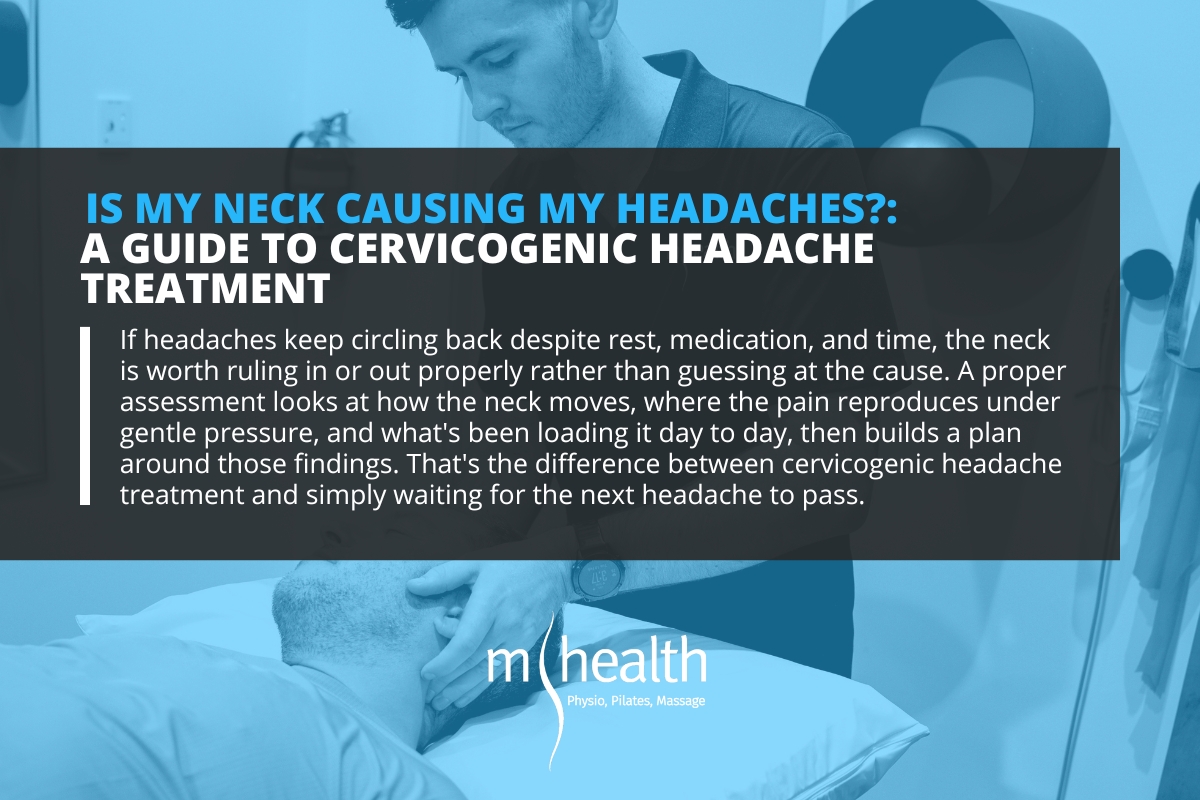
The physio then palpates the joints of the upper cervical spine by hand, feeling for stiffness, tenderness, or muscle guarding around the C1 to C3 segments. In many cases, gentle, specific pressure on these joints will reproduce the exact headache pattern the patient has been living with, which is one of the clearer signs that the neck is genuinely involved rather than coincidental.
This combination of history, movement testing, and hands-on assessment gives a much clearer picture than a self-checklist ever could, and it helps rule out other causes along the way. If anything in the assessment points to a primary migraine disorder, or to symptoms that need urgent medical attention, that gets flagged and referred on rather than treated as a neck problem.
What Cervicogenic Headache Treatment Involves
Once the neck is confirmed as the source, treatment shifts from managing pain after it starts to reducing the load that’s been driving it. This typically combines hands-on techniques to mobilise the stiff upper cervical joints with exercises that build strength and control in the deep neck flexors, alongside practical adjustments to posture and workstation setup. Our physiotherapy team builds this around what the assessment finds rather than a fixed program, since the mix of manual therapy, exercise, and postural work varies depending on how long the pattern has been established.
Most people notice a change within a handful of sessions, though the exact timeline depends on how entrenched the habit or injury behind it has become.
When It Might Not Be Your Neck
A cervicogenic headache is common, but it’s not the only explanation for recurring head pain, and physiotherapy isn’t the right first step for every headache. See a doctor straight away, rather than booking a physio appointment, if a headache comes on suddenly and severely, follows a head injury, or arrives with fever, vision changes, slurred speech, or numbness. Headaches that closely match a migraine pattern, with throbbing pain, nausea, and sensitivity to light, may also need a different management approach running alongside any neck-related treatment.
Cervicogenic Headaches: Your Questions Answered
| Question | Answer |
|---|---|
| How do I know if my headaches are coming from my neck? | A neck-related headache typically stays on one side, starts at the base of the skull, and worsens with neck movement or long periods at a screen. Pressing on the muscles at the top of the neck often reproduces the pain. These signs suggest a cervicogenic headache, though a physiotherapy assessment can confirm it. |
| What is a cervicogenic headache? | A cervicogenic headache is head pain caused by problems in the upper neck, usually the C1 to C3 vertebrae. Because nerve pathways from the neck and head overlap, irritation in these joints or muscles can be felt as a headache, even though the issue originates in the cervical spine. |
| What’s the difference between a cervicogenic headache and a migraine? | A cervicogenic headache tends to feel like a steady ache linked to neck movement and posture, while a migraine usually throbs and comes with nausea or sensitivity to light. Migraines can occur on either side and aren’t typically reproduced by pressing on the neck. |
| Can screen time cause headaches at the back of the head? | Yes. Long periods spent looking down at a phone or forward at a screen put sustained load on the small muscles at the base of the skull. Over time, this can irritate the upper cervical joints and trigger a headache that starts at the back of the head. |
| What does cervicogenic headache treatment involve? | Treatment usually combines manual therapy to mobilise the stiff upper neck joints, exercises to strengthen the deep neck flexors, and practical changes to posture and workstation setup. The exact plan depends on what a physiotherapy assessment finds, rather than following a fixed program. |
New Headache Resource Released Today
 Mentone is a leafy bayside suburb in Melbourne’s south-east. mHealth offers Physiotherapy in Mentone and surrounding suburbs, including Sandringham, Black Rock, Mordialloc, Cheltenham, Parkdale and Beaumaris.
For anyone whose headaches keep returning despite rest and medication, mHealth’s new guide, Is My Neck Causing My Headaches? A Guide to Cervicogenic Headache Treatment is a useful starting point for understanding whether the neck could be involved. The article walks through the warning signs, how a physiotherapy assessment works, and what to expect if the upper cervical spine turns out to be the source. Readers keen to learn more, or to book a consultation to discuss Headache Treatment options tailored to their situation, are encouraged to reach out to the friendly team at mHealth Mentone directly to arrange an appointment or ask any questions.


Contact Information:
MHealth
Unit 2/3 Swanston St
Mentone, VIC 3194
Australia
Steve Ajzenman
https://www.mhealth.com.au/


