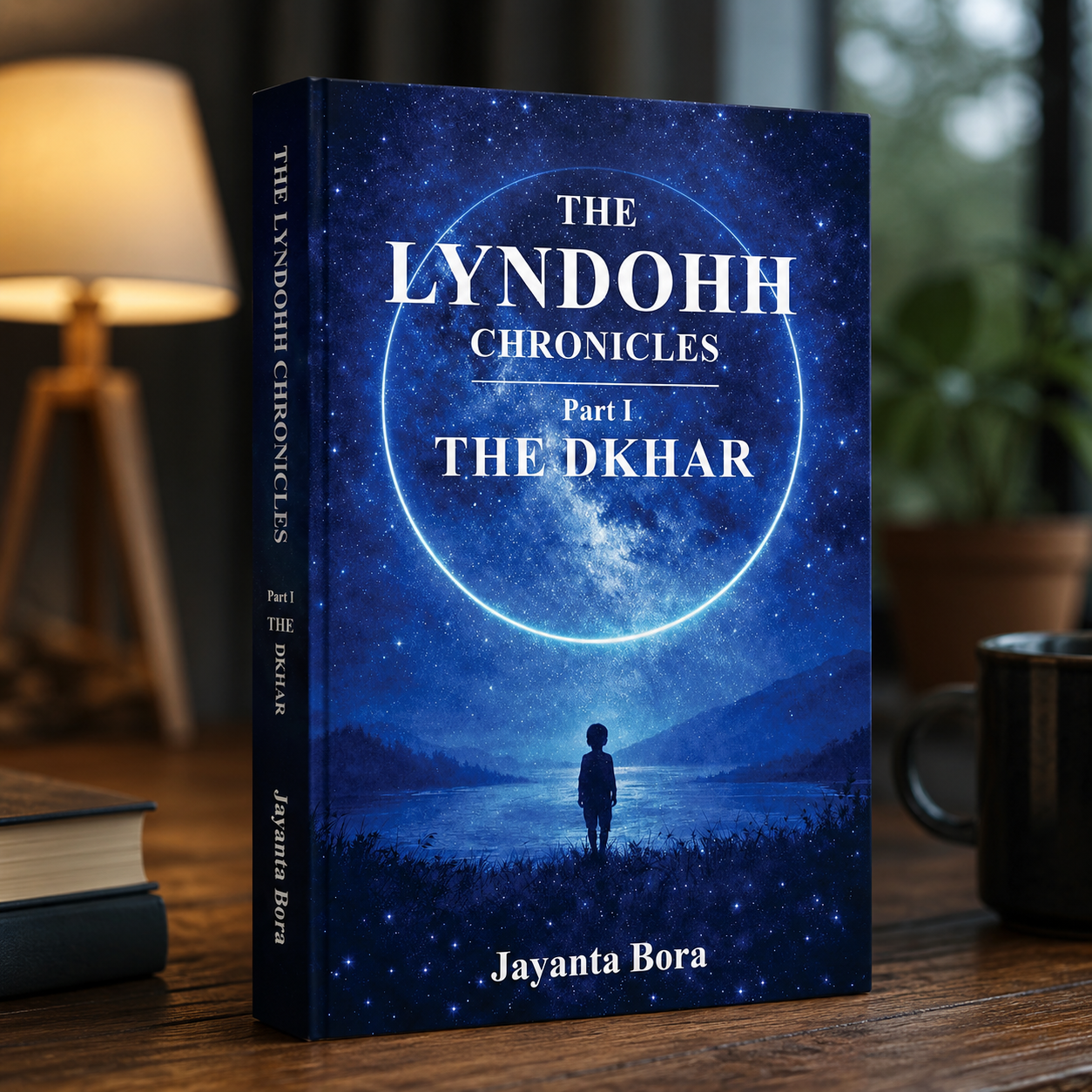
Jayanta Bora’s THE DKHAR begins a compelling trilogy about memory, identity, belonging, and one man’s search for home.
LONDON, UNITED KINGDOM, June 11, 2026 /EINPresswire.com/ — Jayanta Bora introduces readers to a deeply atmospheric and emotionally layered new novel with THE LYNDOHH CHRONICLES: THE DKHAR, published on 28 May 2026. The book marks the opening volume of The Lyndohh Chronicles, a trilogy that follows Lyndohh, a man shaped by Shillong, haunted by memory, and marked by a word that refuses to leave him: Dkhar.
In Khasi, “Dkhar” can mean outsider, stranger, settler, or someone who is simply “not us.” In Bora’s novel, the word becomes more than a label. It becomes a wound, a question, and a lifelong force in Lyndohh’s search for clarity. The story asks what happens when a person is formed by a place yet made to feel separate from it, and what it takes to return to that place after decades of silence, shame, longing, and distance.
A Return Sparked by a Number
The novel begins in Southsea, where Lyndohh lives with Inya near the sea. Their quiet life is interrupted by the recurrence of the number 10766, a sequence that has followed Lyndohh across time, countries, memories, and personal thresholds. When the number becomes connected to a £28 million UK Lotto win, the event does not function as a simple stroke of luck. It becomes a turning point.
The lottery win gives Lyndohh the means to return to Shillong and to the house at Barik, the place where childhood, ancestry, loss, and identity remain locked inside the rooms and gates of memory. Yet this is not a story about wealth. It is a story about consequence. Money opens the door, but memory is what pulls him through it.
The House at Barik
At the centre of the first book is the old house at Barik. For Lyndohh, the house is not merely property. It is the architecture of belonging. It carries the presence of Pa, Mei, childhood routines, family conversations, radio broadcasts, school memories, old embarrassments, and the first lessons of difference.
When Lyndohh returns to the rusted gate, he is not simply revisiting a childhood home. He is facing the version of himself that was left behind there. His desire to lease and restore the house for ninety-nine years becomes one of the novel’s most symbolic gestures. He does not want to erase the past or rebuild it into something modern. He wants to preserve its original shape, because the house itself remembers what he has spent a lifetime trying to understand.
Shillong as Memory, Not Setting
Bora’s Shillong is alive with sound, weather, scent, and cultural memory. The city is built through mist, pine, rain, tea shops, school corridors, markets, old radios, church echoes, curfews, and the slow pressure of social change. Places such as Barik, St Edmund’s, Tripura Castle, Iewduh, Laitumkhrah, Motphran, and Wards Lake appear not as decorative locations, but as emotional territories.
The novel captures a Shillong that is intimate, beautiful, uneasy, and deeply remembered. It is a city that raised Lyndohh, tested him, and never fully released him. Through this landscape, the book explores how place can become part of the body, how geography turns into memory, and how memory can return with the force of reckoning.
Growing Up Between Belonging and Difference
As the narrative moves through childhood and adolescence, The Dkhar explores the experiences that shape Lyndohh’s identity. School life, friendships, family tensions, first desires, humour, shame, discipline, rebellion, and emotional confusion all become part of his formation.
The word Dkhar enters his inner life with painful force. It affects how he sees his father, how he understands himself, and how he negotiates social belonging in a community where identity is never simple. Bora does not treat outsiderhood as a single dramatic event. He presents it as something that accumulates through language, class, accent, culture, inheritance, and the quiet wounds of growing up.
The Pull of Escape
The later movement of the book enters darker emotional territory through the chapter titled “Colour Purple.” Here, the story explores youthful indulgence, dependency, escape, and the temporary euphoria of belonging through sensation. The colour becomes symbolic of more than substance. It reflects the desire to numb confusion, join a group, outrun shame, and survive the pressures of adolescence.
Bora handles this material as part of Lyndohh’s larger journey rather than as spectacle. These experiences are shown as emotional evidence, revealing how a young man searching for identity can be drawn toward risk, ritual, friendship, and release.
A Trilogy of Exile and Becoming
As the first volume of The Lyndohh Chronicles, The Dkhar lays the foundation for a wider journey that stretches beyond Shillong. The manuscript points toward Bombay, the United States, and Kazakhstan, where Lyndohh’s sense of outsiderhood continues to evolve. What begins as a word attached to place becomes a method of survival, a defence, and eventually a way of understanding the self.
The novel’s movement is not strictly linear. It follows the rhythm of memory, returning to images, numbers, sounds, and places until they begin to reveal their meaning. Through Lyndohh’s story, Bora examines exile not only as geography, but as a condition of being.
Publication and Reader Relevance
Published on 28 May 2026, THE LYNDOHH CHRONICLES: THE DKHAR is available on Amazon and will appeal to readers who are drawn to layered storytelling, cultural depth, coming-of-age narratives, memory-driven novels, and stories about identity, displacement, return, and self-understanding.
The book speaks to anyone who has ever felt between worlds, attached to a place yet unsettled by it, or shaped by a word they did not choose. Through Lyndohh’s return, Jayanta Bora opens a story about what it means to be named, to remember, to leave, and to come back changed.
About the Author
Jayanta Bora is the author of THE LYNDOHH CHRONICLES: THE DKHAR. His writing explores memory, identity, culture, place, and the emotional inheritance people carry across time and geography. Through The Lyndohh Chronicles, Bora introduces an expansive narrative shaped by Shillong, Southsea, exile, return, and the enduring human search for belonging.
Jayanta Bora
People & Culture Strategist
+44 7904 083597
jbora1@yahoo.com
Visit us on social media:
LinkedIn
Legal Disclaimer:
EIN Presswire provides this news content “as is” without warranty of any kind. We do not accept any responsibility or liability
for the accuracy, content, images, videos, licenses, completeness, legality, or reliability of the information contained in this
article. If you have any complaints or copyright issues related to this article, kindly contact the author above.

Media gallery