
Texas’ Oil and Gas Industry Could Unlock More Than 30 Gigawatts of Firm Geothermal Electricity in the Lone Star State
PR Newswire
AUSTIN, Texas, Nov. 17, 2026
New analysis finds that a revolving state loan program deploying $2 billion in geothermal development financing would help unlock more than 30 GW of dispatchable geothermal power in Texas, equivalent to roughly one-third of Texas’ record peak electricity demand, while supporting the local workforce and returning the state’s capital investment
AUSTIN, Texas, Nov. 17, 2026 /PRNewswire/ — Project InnerSpace has published ‘The Texas Geothermal Development Fund: Investing in the Next Century of Energy Abundance and Deploying Texan Oil and Gas Talent to Unlock Geothermal at Scale,‘ an analysis examining how Texas can deploy its oil and gas industry to develop a major local source of firm, dispatchable electricity as the state’s power demand reaches new highs.
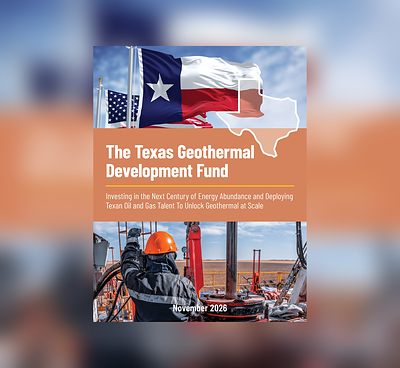
Since 2022, Project InnerSpace has worked to develop a robust set of geothermal capacity and financial frameworks to assess how much geothermal energy can be deployed in countries, states, and regions around the world, and at what cost. These frameworks are being used by the InnerSpace family of entities to assess geothermal development potential on a planetary scale, and to build structures and frameworks aimed at enabling that potential. This analysis is the first of a series-of-its-kind, leveraging these frameworks into a specific model for local action — and because everything is bigger in Texas, there was no better place to start.
‘The Texas Geothermal Development Fund‘ envisions a revolving state loan program built to accelerate geothermal development in Texas. The analysis concludes that if Texas developed such a program, a one-time $400 million investment could deploy approximately $2 billion in geothermal exploration financing over 15 years by repeatedly lending and recovering the same capital. That investment could help unlock more than 30 gigawatts of firm, dispatchable electricity in the Lone Star State, up to $235 billion in private investment, $14 billion in state and local tax revenues, and 939,000 job years (an average of 62,600 jobs per year), all while leaving approximately $450 million in the program. The broader return would be a thriving and home-grown Texas geothermal industry capable of continued organic growth without additional state support.
The barrier that the state loan program seeks to solve is early stage financing risk. Geothermal developers must spend millions drilling wells and acquiring data to prove a geothermal resource exists, and conventional lenders won’t finance that risky early stage. The proposed revolving state loan program would share that cost and risk, allowing for loan repayment after a resource is proven and traditional project financing enters. After repayment, the funds revolve to support the next project. The envisioned structure involves no ratepayer charges, no generation mandates, and no changes to ERCOT’s market design.
The opportunity builds on Texas’ substantial geothermal resources and existing oil and gas industry and workforce. In total, the analysis finds, Texas has roughly 140 gigawatts of technical geothermal electricity potential, a number orders of magnitude larger than what the envisioned state loan program would enable — paving the way for sustained and massive future growth of the geothermal development in the state.
“Texas helped develop the drilling technologies that are making next-generation geothermal possible, yet much of the investment and development is happening in other states,” said Barry Smitherman, Chairman of Texas Geothermal Energy Alliance. “We already have the workforce, equipment, and expertise to build this industry here. This program would bring those projects home, creating jobs for Texas workers, and continuing Texas’ legacy of global energy leadership.”
There is precedent for this type of action in Texas. In 2025, the Texas Legislature created and funded a $350 million Advanced Nuclear Development Fund, even though nuclear energy was already eligible for financing through the Texas Energy Fund. Geothermal faces a similar early-stage financing gap to nuclear, but carries the additional benefits of local workforce deployment and oil and gas industry leadership in its development.
Key Findings from the ‘Texas Geothermal Development Fund’ Analysis:
- Capital: A $400 million revolving loan program could deploy approximately $2 billion over 15 years by recycling repayments, with developers contributing another $499 million of their own capital;
- Projects: The program could de-risk approximately 55 geothermal projects;
- Electricity: Successful projects emerging from the de-risking phase could catalyze over 30 gigawatts of dispatchable, baseload electricity generation in Texas;
- Private Investment: The program could catalyze up to $235 billion in downstream private investment to build geothermal projects in Texas, equivalent to approximately $588 for every dollar of initial state funding;
- Fiscal Returns: After 15 years, approximately $450 million would remain in the program, after program administration costs and including interest earned on cash held between rounds; the program would also generate $14 billion in state and local tax revenues;
- Jobs and Economic Development: The program would create 939,000 job years (an average of 62,600 jobs per year) providing a new market for Texas-based workforce, drilling rigs, operators, oilfield-service companies, and suppliers.
“This report offers a path to a transformative, affordable, bipartisan investment in Texas’s economy and its power grid. Our state’s pioneering history in the oil fields can unlock a powerful new clean, dispatchable energy resource — and do so in a way that repays taxpayers,” said Drew Nelson, VP of Strategy of Project InnerSpace. “The Texas Legislature will obviously weigh a number of different energy ideas during the upcoming legislative session, but few can have as big of an impact as this revolving loan program.”
Project InnerSpace and Texas Geothermal Energy Alliance will present the findings in an online webinar on November 17 at 2 p.m. CT.
Read the ‘Texas Geothermal Development Fund‘ analysis here: https://projectinnerspace.org/resources/texasgeothermaldevelopmentfund.pdf
About Project InnerSpace
Project InnerSpace is the leading independent non-profit organization dedicated to the global development of geothermal energy. We are a focused research organization, on a mission to remove the major barriers standing in the way of the exponential growth and development of geothermal energy worldwide by 2030. Project InnerSpace proudly began its work in 2022 in Texas, with publication of the ‘Future of Geothermal in Texas.’ To learn more about Project InnerSpace, please visit www.projectinnerspace.org.
About Texas Geothermal Energy Alliance (TxGEA)
The Texas Geothermal Energy Alliance (TxGEA) is a Texas-based, Texas-led advocacy organization created for the purpose of advancing geothermal energy in Texas. TxGEA is comprised of a broad and interdisciplinary group of entities engaged in geothermal resource exploration, well drilling, plant construction, resource production and markets. These supporters include representatives from the oilfield service sector, oil & gas operators, utilities, start-up companies working to advance geothermal relevant technologies, and leading scientists and engineers from a number of academic institutions across Texas. To learn more about TxGEA, please visit www.txgea.org.
 View original content to download multimedia:https://www.prnewswire.com/news-releases/texas-oil-and-gas-industry-could-unlock-more-than-30-gigawatts-of-firm-geothermal-electricity-in-the-lone-star-state-302941269.html
SOURCE Project InnerSpace


