
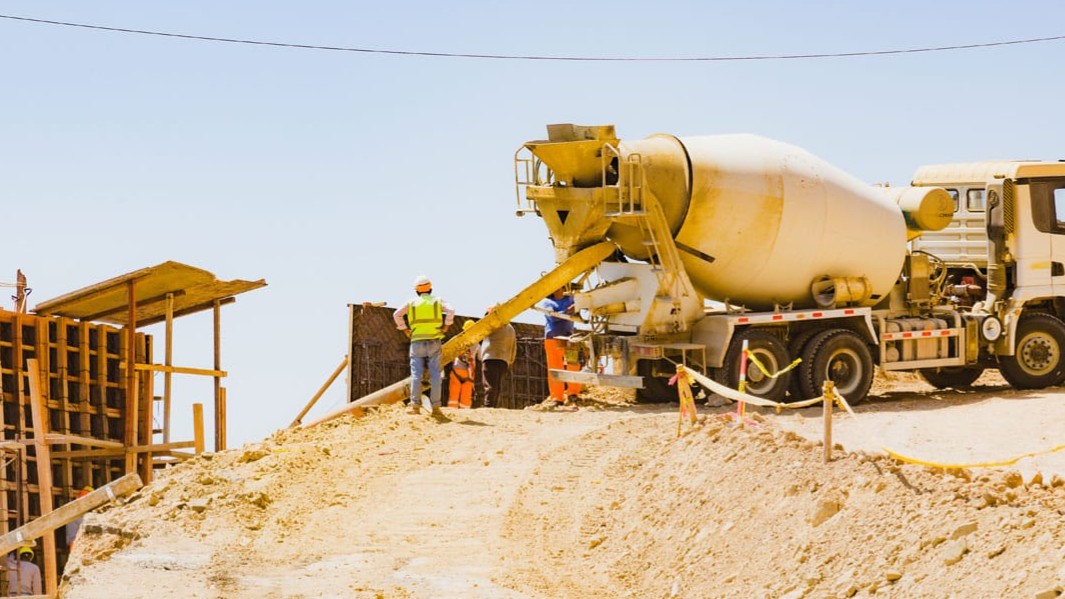
A cement mixer backs toward a fresh foundation pour while crews work around it. Another truck waits at the gate, a subcontractor’s pickup cuts across the lot and a spotter steps away for a moment. On a busy Texas construction site, that is an ordinary morning. It is also how serious injuries happen.
When a cement truck causes an accident on or next to a job site, the question of who is responsible rarely has a single answer. The driver, the trucking company, the concrete supplier and the companies running the site can each play a part.
Key Takeaways
- Cement mixers are top-heavy vehicles, and construction sites add tight spaces, uneven ground, and people on foot.
- Delivery time pressure can push drivers to rush, both on the road and on the site.
- A single accident can involve the driver, the trucking company, the concrete supplier, the site operator, a maintenance contractor or a parts manufacturer.
- Injured construction workers may have a workers’ compensation claim and, separately, a third-party claim against other companies.
- Truck data, dispatch records and site evidence can be lost quickly if no one asks for them to be preserved.
Why Cement Trucks Are Dangerous on Job Sites
The rotating drum on a concrete mixer raises the truck’s center of gravity well above that of a flatbed or box truck. Sharp turns, quick maneuvers and uneven ground increase the risk of a rollover.
Construction sites make those risks harder to manage. Access roads may be unpaved or sloped. Space is tight around forms, materials and equipment. Workers are often on foot, close to moving vehicles, and the noise of a busy site can drown out a backup alarm.
The León Law Firm’s guide to cement truck accidents in Texas explains how these vehicles differ from other commercial trucks and why cases involving them involve different evidence and defendants.
The Delivery Clock
Ready-mix concrete is on a timer. Industry practice under the ASTM C94 standard for ready-mixed concrete has traditionally called for discharge within roughly 90 minutes of mixing, because fresh concrete loses workability as it sits in the drum.
That clock shapes every part of the delivery. On the road, it can lead to speeding and aggressive lane changes. On the site, it can lead to rushed backing, skipped spotters and unloading before the area is clear. Long shifts add another layer of risk. The firm’s guide to truck driver fatigue and hours-of-service violations explains how tired driving is proven in commercial truck cases.
Who Can Be Responsible
Cement truck accidents on construction sites often involve several companies, each with its own duties.
- The driver. Speeding, distraction, fatigue, unsafe backing or operating without a valid commercial license can all be direct negligence.
- The trucking company. A company is generally responsible for its driver’s conduct on the job. It can also be liable for negligent hiring, training, supervision, or maintenance.
- The concrete supplier. When delivery quotas or tightly booked schedules create the pressure behind a crash, the supplier may share responsibility.
- The job site operator or general contractor. If unsafe unloading conditions, poor traffic control or unsafe site access contributed to the accident, the company running the site may be named as a defendant.
- A maintenance contractor. If a third party serviced the brakes or drum and the work was done poorly, that contractor may be responsible.
- A parts manufacturer. When brakes, drum bearings or steering components fail because of a defect, a product liability claim may apply.
The number of responsible parties matters because it affects how much insurance is available. A single driver’s policy can run out quickly. Suppliers and contractors often carry much larger commercial and umbrella policies.
When the Injured Person Is a Construction Worker
Workers on the site face a different set of rules than passing motorists. An injured construction worker may have rights under workers’ compensation through the employer. Construction sites, however, usually involve several companies working at the same time.
If a cement truck driver who works for a different company, a supplier, another contractor or an equipment manufacturer caused the injury, the worker may be able to bring a separate third-party claim against that company. Third-party claims can cover losses that workers’ compensation does not. Safety rule violations, including OSHA violations, can be strong evidence of negligence in those claims.
The firm’s Texas construction site accident attorneys handle claims involving falls, machinery, struck-by accidents and multi-company job sites.
The Evidence That Matters
Cement truck cases depend on records held by the companies involved. Important evidence often includes:
- The truck’s engine control module data and GPS records, which show speed, braking and location
- Hours-of-service and electronic logging data, which show how long the driver had been working
- Dispatch communications and delivery schedules, which can show time pressure
- Maintenance and inspection records for the brakes, drum and steering
- Site records, including traffic control plans, safety inspection records and incident reports
- Photos, video and witness statements from the site
Construction sites change quickly. Debris gets cleared, equipment moves and conditions are repaired. Trucking and supply companies are not always required to keep records unless asked. Send a written request to preserve evidence as early as possible, and the firm’s guide on what to do after a truck accident in Texas covers those first steps.
Shared Fault and Deadlines
Companies in these cases often blame one another, and sometimes the injured person. Under Chapter 33 of the Texas Civil Practice and Remedies Code, a recovery is reduced by the injured person’s share of fault and barred if that share is more than 50 percent.
Most personal injury lawsuits in Texas must be filed within two years under Civil Practice and Remedies Code § 16.003. In wrongful death cases, the two years generally run from the date of death. Injured workers should also report the injury to the employer right away, since workers’ compensation has its own notice rules.
Getting Help After a Cement Truck Accident
Cement truck accidents on construction sites involve commercial trucking rules, construction safety standards and several companies pointing at one another. The Texas 18-wheeler and commercial truck accident lawyers at The León Law Firm investigate every responsible party and handle claims statewide in English and Spanish.
About The León Law Firm
The León Law Firm, P.C. is a bilingual personal injury firm based in Sugar Land, Texas, founded in 1995 by attorney Carlos A. León. The firm represents people injured in car, truck and motorcycle crashes, workplace accidents and other serious incidents throughout Texas, in both English and Spanish. The firm handles cases on a contingency-fee basis, with no fee or case expenses unless it recovers money.
The León Law Firm, P.C.
1 Sugar Creek Center Boulevard
Sugar Land
TX
77478
United States


