The Board Discussions at the ASMFC 2025 Annual Meeting Show the Commission Gave Greater Practical Weight to Charter, Recreational and Service-Economy Impacts in Their Striped Bass Debate Than to Union Workers and Working Families in the Menhaden Industry
WASHINGTON, D.C. / ACCESS Newswire / May 5, 2026 / An MFC analysis of two board meetings held as part of the 2025 Annual Meeting of the Atlantic States Marine Fisheries Commission last Fall finds that the Commission treated socio-economic impacts as central to striped bass management decisions, while giving less practical weight to comparable concerns raised by the menhaden reduction industry, including vessel crews, plant workers, union families, and local communities dependent on the fishery.
The analysis, titled “When Jobs Count, and When They Don’t,” compares the Atlantic Striped Bass Management Board meeting and the Atlantic Menhaden Management Board meeting, both held as part of the ASMFC’s 2025 Annual Meeting. The analysis examines how much attention each Board gave to jobs, business impacts, working waterfronts, associated industries, and the livelihoods of people directly affected by regulation.
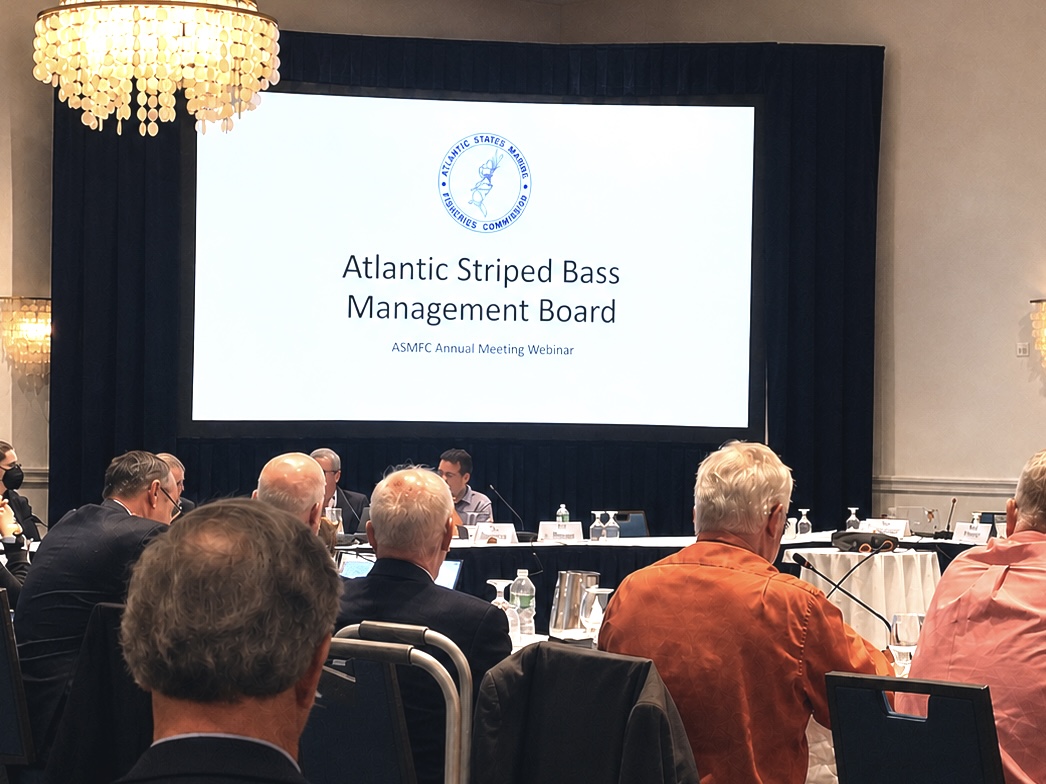
In the Atlantic Striped Bass Management Board meeting, speakers and commissioners repeatedly discussed the economic consequences of further restrictions for charter boats, for-hire operators, commercial fishermen, recreational fishing businesses, tackle manufacturers, bait suppliers, hotels, restaurants, fuel businesses, and coastal communities. Those concerns helped shape the outcome: The Board decided not to move forward with the proposed 12 percent reduction in fishery removals, despite consensus that the striped bass population is below its Target population. Instead, the Board chose status quo rather than an additional reduction and created a work group to examine the future of striped bass management with representation from “all sectors.”
In the Atlantic Menhaden Management Board meeting, representatives of the menhaden reduction fishery described local jobs, generational labor, family livelihoods, harassment of fishermen, bait-market impacts, and the economic dependence of workers in and around Reedville, Virginia. Ocean Harvesters’ CEO Monty Deihl stated that “100 percent” of Ocean Harvesters and Omega Protein employees are U.S. residents and that “94 percent live within 15 miles of that plant.” Retired UFCW Local 400 representative Kenny Pinkard told the Board, “I speak for all working people in Virginia,” and reminded commissioners that their decision affected “the livelihood of these gentlemen behind me.”
Yet despite that testimony, the Atlantic Menhaden Management Board moved forward with an immediate 20 percent reduction for 2026, even with the menhaden stock having been recently announced to be healthy, not overfished and not experiencing overfishing. The analysis argues that, while the Board acknowledged menhaden-related economic concerns, it did not treat them with the same depth, breadth or procedural seriousness shown in the striped bass debate.
“The Atlantic Striped Bass Management Board meeting and the Atlantic Menhaden Management Board meeting at the ASMFC’s 2025 Annual Meeting show that the ASMFC knows how to consider human consequences when it chooses to,” the analysis concludes. “The question is why charter trips, tackle sales, hotels, restaurants, and recreational access receive more visible concern than union jobs, plant workers, vessel crews, and working families in the menhaden industry.”
The analysis does not argue that the ASMFC ignored socio-economic concerns in the menhaden meeting. Rather, it argues that those concerns were treated differently. In the striped bass meeting, economic harm helped justify status quo, a broader work group, and a management posture focused on preserving access and industry viability. In the menhaden meeting, socio-economic harm helped moderate the severity of the reduction but did not prevent an immediate cut or produce a comparable worker-centered process.
The result, according to the analysis, is a revealing double standard: Socio-economic impacts appear to become management-relevant when they affect the striped bass recreational, charter, and associated service economy, but receive less forceful treatment when they affect the menhaden reduction industry and its workforce.
Read the full analysis below: “When Jobs Count, and When They Don’t.”
ANALYSIS
When Jobs Count, and When They Don’t
What two ASMFC Annual Meeting board discussions reveal about striped bass, menhaden, and selective concern for working people
The Atlantic States Marine Fisheries Commission knows how to talk about jobs.
It knows how to talk about small businesses, charter captains, tackle shops, bait suppliers, hotels, restaurants, fuel docks, working waterfronts, access, community identity, and the human cost of fishery restrictions. It knows how to pause before imposing cuts. It knows how to ask whether another reduction will push fishermen, captains or dependent businesses past the breaking point.
The Atlantic Striped Bass Management Board meeting and the Atlantic Menhaden Management Board meeting, both held as part of the ASMFC’s 2025 Annual Meeting, show all of that clearly.
But they also show something else: The Commission does not apply that concern evenly.
When striped bass regulation was on the table, socio-economic impacts were treated as a central management concern. Speakers and commissioners returned again and again to the economic consequences for charter boats, for-hire operators, commercial fishermen, recreational fishing businesses, tackle manufacturers, hotels, restaurants, fuel suppliers, and the broader coastal economy built around striped bass. The Atlantic Striped Bass Management Board ultimately rejected a proposed quota cut of 12%, and instead chose status quo on the key reduction question and created a work group to think more broadly about the future of striped bass management.
When menhaden regulation was on the table, the treatment was different. The menhaden reduction industry’s workers were present. Their representatives spoke. Union labor spoke. Vessel captains spoke. People described local jobs, generational work, family impacts, and the economic life of Virginia communities. Yet those concerns were treated less like a reason to pause and more like a factor to manage around while still imposing reductions.
That difference is the story.
The Commission does not ignore socio-economics. It appears to discount them selectively.
How the analysis was done
The analysis compared two board meetings held as part of the 2025 Annual Meeting of the Atlantic States Marine Fisheries Commission: the Atlantic Striped Bass Management Board meeting and the Atlantic Menhaden Management Board meeting. The comparison did not simply look for the word “economic.” That would miss the real issue.
Instead, the meetings were reviewed around three questions.
First, how much attention was given to socio-economic consequences? This included direct references to jobs, businesses, income, cost of inputs, bait supply, charter trips, commercial viability, hotels, restaurants, fuel, tackle, and local economies.
Second, whose socio-economic consequences were treated as legitimate? The relevant comparison is not “economics versus conservation.” It is whether one group’s economic concerns were treated as management-relevant while another group’s were treated as secondary.
Third, what did the Board do after hearing those concerns? The most important evidence is not merely that someone spoke at the microphone. It is whether socio-economic concerns influenced the motion, the compromise, the vote, the creation of a work group or the timing of future management.
On those three questions, the meetings show a striking contrast.
In the Atlantic Striped Bass Management Board meeting, economic harm was treated as a reason to stop and rethink
The Atlantic Striped Bass Management Board meeting was saturated with socio-economic concern.
At the beginning of public comment, Brian Hardman, president of the Maryland Charter Boat Association, described steep business losses. He told the Board that Maryland charter boats had gone from catching 92,816 fish in 2023 to 34,000 in 2024 and 26,000 year-to-date in 2025. “You’ve reduced our businesses by well over 50% in every single category,” he said. “We can’t survive with these continued reductions and closures and try to stay in business.” He also said 54 charter boats had been listed for sale during that period.
Commercial watermen made a similar argument. Captain Robert Newberry of the Delmarva Fisheries Association asked commissioners to look at the fishermen in the room and said, “This is who you’re affecting here today.” He warned that additional cuts would put working watermen “out of business” and distinguished commercial and charter fishing from purely recreational use: “The recreational side, that’s a hobby. We have a living. We pay our bills. We buy vehicles. That is what we do for a living.”
The meeting repeatedly framed striped bass cuts as a direct threat to the survival of fishing businesses and working waterfronts. A commercial fisherman, Nick Manzion, argued that cutting the commercial quota would not “promote American seafood” but “destroy it,” adding: “Every pound taken from the commercial side is one less pound of wild, sustainable, American-caught fish for our people. One less job, one more blow to those who feed the nation.”
Then the Board itself absorbed that frame. Staff summarized public comments as warning of “severe negative economic impacts” and harm to “fishing-related businesses and local economies,” with damage to already struggling for-hire and commercial sectors.
The Advisory Panel summary was even more explicit. The AP report summarized status quo supporters as saying that “the for-hire commercial industries are already disappearing,” that “any season closure would devastate the for-hire industry,” and that “the commercial fishery may no longer be profitable with more cuts.”
The Board heard economic hardship, repeated it, and built it into the decision frame.
Striped bass economics were not limited to fishermen
One reason the striped bass discussion received such weight is that its economic footprint was repeatedly described as broad and multi-layered.
The meeting included discussion of charter boats, private anglers, commercial fishermen, tackle manufacturers, hotels, restaurants, fuel, and other associated businesses. ASMFC Commissioner Ray Kane of Massachusetts asked for a broader white paper, saying he kept hearing about socio-economic impacts and wanted to see how those impacts worked beyond the dockside price of striped bass: “hotels, restaurants, fuel.”
Tom Fote of the Jersey Coast Anglers Association similarly emphasized the recreational economy, saying recreational fishing is “important to my state as far as the business of my state” and pointing to “hundreds of thousands of jobs making tackle and everything else through the country.”
The Advisory Panel also described striped bass as an economic linchpin, describing reduction supporters as saying that “striped bass are the linchpin of the economy” and that they wanted to “ensure a fishery for the future.”
That framing matters. In the Atlantic Striped Bass Management Board meeting, the economic ecosystem around the fish was treated as expansive. The Board did not limit its attention to direct harvesters. It was invited to consider the entire service economy around striped bass: charter trips, equipment, bait, tackle, fuel, travel, hospitality, and coastal community identity.
That is exactly the kind of socio-economic analysis the menhaden reduction industry is asking for – but did not receive in the same way.
The Atlantic Striped Bass Management Board converted economic anxiety into process
The most important evidence is the Board’s response.
A motion for status quo was offered on the striped bass reduction issue, and the motion-maker, Commissioner Adam Nowalsky of New Jersey, described the decision as “an extremely important decision in the name of conservation” and “an extremely important decision in the name of socioeconomics.” He argued that “right now, status quo is the way forward” and that the Board should wait for the next benchmark before responding further.
Commissioner John Clark of Delaware, the seconder of the status quo motion, put the economic concern even more plainly: “If we keep reducing the removals, we’re going to end up in a situation where there are no for-hire commercial fisheries when striped bass do recover.” He warned that the Board could end up saying “the operation was a success, but the patient died.”
That argument carried institutional weight. The Board adopted a status quo approach combined with a work group. The work group was designed to include “representation from all sectors in addition to scientists and managers” and to consider future striped bass management beyond 2029.
The Board then rejected a motion to add a 12 percent reduction and moved forward with status quo plus the work group.
The Board did not merely hear economic concerns. It changed the outcome.
In the Atlantic Menhaden Management Board meeting, the workers were visible – but less protected
The Atlantic Menhaden Management Board meeting also included powerful socio-economic evidence.
Ocean Harvesters’ CEO, Monty Deihl, described the Reedville operation as American-owned and local. “100% of our employees at Ocean Harvesters and Omega Protein, who we sell our fish to, are U.S. residents,” he said. “Ninety-four percent live within 15 miles of that plant.” He also said the debate had made fishermen into targets, describing harassment on the water and threats on social media.
Thomas Moore, a fifth-generation menhaden boat captain for Ocean Harvesters, described a 15-man crew, “most” of whom were present. “They are also generational workers,” he said. “Their ages range from 22 to 66.” Moore added: “We love our jobs and are very passionate about them,” and warned, “Any cuts we face today will hurt us, our families, and our community.”
Most importantly for the labor argument, retired UFCW Local 400 representative Kenny Pinkard spoke directly for working people in Virginia. He identified himself as a third-generation fisherman and said, “I speak for all working people in Virginia.” He asked the captains and crews to stand, telling the Board: “You all do have something to do with the livelihood of these gentlemen behind me.” The message the Board sent, he said, was the message those workers would have to take home “to their wives” and “their children.”
That is exactly the type of human evidence that, in the striped bass context, helped justify caution, status quo, and a future work group.
But in the menhaden context, it did not receive the same treatment.
The Atlantic Menhaden Management Board acknowledged socio-economics, then moved past them
To be fair, the Atlantic Menhaden Management Board did not ignore economics altogether.
Several commissioners raised socio-economic concerns. Commissioner Joe Grist of Virginia, where Ocean Harvesters is located, warned that reductions beyond 20 percent would put at risk “directly or indirectly, hundreds, if not thousands of American jobs across several states.” He also warned that cuts would reduce supply and increase prices for menhaden used by both commercial and recreational fishing industries.
Commissioner Eric Reid of Rhode Island then said the disparity of concern between the fisheries out loud: “When we talk about striped bass, we talk a lot about socioeconomics, and we’re not talking about it here.”
The Commission itself, through the words of a board member, recognized the asymmetry. Socio-economic concern was not absent from the menhaden meeting, but it was thinner, more defensive, and less powerful than in the striped bass meeting.
The Menhaden Board did ultimately reject the deepest immediate cut. But the final path still imposed a 20 percent reduction for 2026, with the Board planning to revisit 2027 and 2028 later. That motion carried 16-2.
So yes, there was some accommodation. But the comparison remains: striped bass socio-economics helped produce status quo and a work group; menhaden socio-economics helped reduce the severity of the cut, but still resulted in an immediate 20 percent reduction.
The menhaden workforce was treated as a cost, not a constituency
In the Atlantic Striped Bass Management Board meeting, affected stakeholders were treated as constituencies whose future needed to be built into management. The Board created a process for them.
In the Atlantic Menhaden Management Board meeting, workers were treated more like costs to be balanced against ecological targets. Their testimony mattered, but it did not reorganize the Board’s response in the same way.
The menhaden workforce is not faceless. The meeting was attended by local, generational, unionized labor. Vessel crews attended the meeting. They showed workers tied to a particular place in Virginia. It showed families whose economic stability depends on the reduction fishery.
The menhaden workforce includes a significant minority labor force. The public record shows this with workforce demographics. Although information presented in the meeting demonstrated the importance of the union, local, and generational labor, it does not appear, from the reviewed material, to show the Board developing or centering a serious labor-equity record before making a decision affecting those workers.
A commission that can discuss hotels, restaurants, fuel, tackle, charter trips, and recreational access for striped bass can also discuss union jobs, plant labor, vessel crews, minority employment, wage security, and community and customer dependence in the menhaden reduction fishery.
The Atlantic Menhaden Management Board meeting at the ASMFC’s 2025 Annual Meeting shows that it largely did not.
The double standard becomes clearer when “associated industries” are compared
The striped bass discussion treated associated industries expansively. The Board heard about charter vessels, tackle manufacturers, hotels, restaurants, fuel, and the broader business ecosystem around recreational fishing.
The menhaden discussion also contained associated-industry impacts. Ross Kellum, who identified himself as owning and operating a vessel in the purse seine bait fishery, warned that any change in the TAC would induce volatility in the bait marketplace. He said higher prices would mean “the lobstermen in New England will no longer be able to afford to work,” “the crabbers of Maryland and Virginia won’t be able to afford to work,” and “chum prices will skyrocket” and depress recreational activity along the Atlantic Coast.
Patrice McCarron of the Maine Lobstermen’s Association said excessive quota cuts would cause “significant harm to Maine’s lobster industry,” describing a fleet of 4,300 lobstermen and 800 students who sustain local families and coastal economies.
So the economic web around menhaden was real and documented. But it was treated differently.
For striped bass, the surrounding economy helped justify restraint.
For menhaden, the surrounding economy was acknowledged, then placed behind the ecological reference point framework and the desire to support striped bass and other predators.
Striped bass was allowed complexity; menhaden was compressed into a forage function
In the Atlantic Striped Bass Management Board meeting, the fishery was viewed as complicated. The Board discussed recruitment failure, environmental change, fishing mortality, MRIP uncertainty, the 2027 benchmark, Maryland’s baseline, charter impacts, commercial impacts, and stakeholder distrust. The solution was not simply “cut more.” It was “pause, study, involve people, and build a better process.”
In the Atlantic Menhaden Management Board meeting, the species was discussed less as a fishery with its own human community and more as an input into ecosystem management, especially striped bass recovery. The ERP presentation described menhaden reference points in relation to striped bass biomass, explaining that the ERP target is defined to allow striped bass to stay at their biomass target when striped bass are fished at their target fishing mortality.
That is not necessarily wrong biologically. Menhaden is a forage species. But it is incomplete as social policy. A fishery can be ecologically important and still be economically important. A reduction industry can be industrial and still be made of workers. A quota cut can be scientifically defensible and still require serious labor analysis.
The problem is not that the Commission considered ecosystem needs. The problem is that, compared with striped bass, it gave less institutional dignity to the human economy attached to menhaden.
Jobs Matter Sometimes
The strongest case is not that the ASMFC never mentioned menhaden jobs. It did. But menhaden jobs were not treated with the same depth, breadth or procedural seriousness as striped bass jobs.
For striped bass, socio-economic harm helped reject a 12% reduction, and led to the formation of a broad work group, a future white-paper-style analysis, and a management posture focused on preserving access and industry viability.
For menhaden, socio-economic harm helped moderate the size and timing of reductions, but it did not prevent an immediate 20 percent cut. Nor did it produce the same worker-centered process focused on union labor, vessel crews, plant labor, minority employment, and community dependence.
That is unequal treatment.
The Commission treated socio-economic concerns as central when the affected economy is the striped bass recreational and charter complex. But when the affected economy is the menhaden reduction industry – its crews, plant workers, union families, and local Virginia communities – those concerns become secondary, something to acknowledge before moving back to ecological targets.
Selective Caring
The Atlantic Striped Bass Management Board meeting and the Atlantic Menhaden Management Board meeting, both held as part of the ASMFC’s 2025 Annual Meeting, show that the ASMFC knows how to care about people. It knows how to discuss jobs, businesses, local economies, and the survival of fishing-dependent communities. The Atlantic Striped Bass Management Board meeting proves that.
However, their concern decreases when the people in question work in the menhaden reduction industry.
Those workers are not abstractions. They are captains, crews, plant employees, union members, families, and local residents. They are part of the American seafood economy. Their customers are those who use the products to feed those fish and animals that then feed humans, or feed their pets, or directly used by humans to improve their health. They should not have to prove, again and again, that their jobs count as real jobs.
Taken together, the Atlantic Striped Bass Management Board meeting and the Atlantic Menhaden Management Board meeting at the ASMFC’s 2025 Annual Meeting reveal a double standard: Socio-economic impacts are treated as management-relevant when they affect the striped bass recreational, charter, and associated service economy, but not given comparable weight when they affect the menhaden reduction industry and its workforce.
That is not balanced fishery management. It is selective empathy. And if empathy can be shown for those dependent on a stock deemed Overfished, then why not for a stock that has seen neither overfishing, or being overfished, for over 30 years?
About the Menhaden Fisheries Coalition
The Menhaden Fisheries Coalition (MFC) is a collective of menhaden fishermen, related businesses, and supporting industries. Comprised of businesses along the Atlantic and Gulf coasts, the Menhaden Fisheries Coalition conducts media and public outreach on behalf of the menhaden industry to ensure that members of the public, media, and government are informed of important issues, events, and facts about the fishery.
Press Contact
Menhaden Fisheries Coalition
(202) 595-1212
www.menhaden.org
SOURCE: Menhaden Fisheries Coalition
View the original press release on ACCESS Newswire


